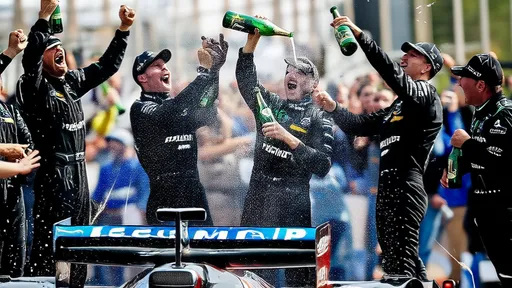
The iconic champagne spray celebration at the 24 Hours of Le Mans represents one of motorsport's most joyous and chaotic traditions. What began as a simple victory toast has evolved into an exuberant ritual where drivers drench each other, team members, and occasionally even officials in bubbling French champagne. The sight of exhausted but elated winners violently shaking bottles before unleashing fizzy torrents has become as much a part of Le Mans lore as the race itself.
The origins of this effervescent tradition trace back to 1967 when American Dan Gurney and Belgian Jackie Ickx took victory for Ford. In a spontaneous moment of celebration, Gurney shook his magnum of Moët & Chandon and sprayed it over the crowd from the podium. This unplanned gesture created an instant tradition that would become mandatory theater for all future winners. Gurney's improvisation perfectly captured the release of tension after 24 grueling hours of racing while adding a touch of playful rebellion to the formal podium proceedings.
There's an art to the champagne shake that goes beyond mere celebration. The violent agitation serves the very practical purpose of building maximum pressure inside the bottle. When the cork finally releases, the results become far more spectacular - a geyser of foam rather than a gentle pour. Drivers typically hold bottles at a 45-degree angle while shaking, allowing the bubbles to expand properly before the big moment. The technique matters; veterans know that over-shaking can make the bottle difficult to open while under-shaking produces disappointing results.
Why has this particular celebration endured when so many other motorsport traditions have faded? Part of the answer lies in Le Mans' unique character. The race demands so much sacrifice - from drivers pushing beyond exhaustion to mechanics working through the night - that the champagne spray becomes a physical manifestation of pressure released. The madness of the spraying mirrors the madness of the event itself. Where Formula 1 podiums remain relatively dignified affairs, Le Mans encourages this beautiful chaos as the perfect counterpoint to the discipline required during the race.
The champagne brand matters almost as much as the shaking technique. Since 1995, the official champagne of Le Mans has been G.H. Mumm, though Moët & Chandon and other premium brands have featured in earlier years. The race organizers insist on proper French champagne - no substitutes allowed. This insistence on authenticity maintains the connection to Le Mans' French roots while ensuring the spray has the proper volume and bubble quality that cheaper sparkling wines can't match.
Some of the most memorable champagne moments come from mishaps rather than perfect execution. In 2008, Tom Kristensen accidentally launched an unopened bottle into the crowd when the cork flew prematurely. The following year, David Brabham managed to spray himself in the face more thoroughly than his teammates. These unscripted moments add to the celebration's charm and remind us that even highly trained professionals can't always control the champagne chaos.
The psychology behind the ritual reveals deeper meanings. After spending a full day and night operating at peak focus, the champagne spray allows drivers to transition back to normal human interaction through shared, childlike joy. The act of soaking others - and being soaked in return - creates instant camaraderie among winners who may have been rivals just hours before. Neurologists suggest the combination of sugar, alcohol and bubbles triggers genuine pleasure responses, making this the perfect physiological reward after extreme endurance.
Team strategies for champagne warfare have evolved over the decades. Some drivers now practice their shaking techniques beforehand, while teams occasionally position extra bottles around the podium for ambush attacks. The introduction of magnum bottles in the 1990s escalated the spray volume dramatically, leading to the current era where entire crews get drenched. Safety measures have been implemented too - officials now insist corks be loosely twisted rather than fully inserted to prevent eye injuries from high-velocity projectiles.
Women drivers have put their own stamp on the tradition. When Danica Patrick stood on the LMP2 podium in 2011, she delivered one of the most aggressive champagne shakes in recent memory, proving the celebration isn't about gender but about unleashing pent-up energy. Similarly, Vanina Ickx (daughter of Jackie) became renowned for her ability to spray champagne while simultaneously lighting a cigar - a multitasking feat few male drivers have attempted.
The environmental impact of this tradition hasn't gone unnoticed. In recent years, some teams have experimented with more controlled celebrations to reduce waste, while organizers have introduced biodegradable confetti alternatives. Yet the champagne spray persists because, as sustainability consultant Marie Bouvet notes, "Some traditions carry such cultural weight that their carbon footprint becomes part of their value equation. The Le Mans spray represents maybe five bottles out of the millions consumed globally each day."
Television has played a crucial role in cementing the champagne shake's place in motorsport culture. Slow-motion replays of golden liquid arcing through the air create some of the race's most shareable moments. Broadcasters know to keep cameras rolling well after the checkered flag falls, anticipating the inevitable champagne chaos. This media amplification transformed what began as one driver's improvisation into an expected ritual that fans anticipate as much as the racing itself.
What does the future hold for this fizzy tradition? As safety regulations tighten across motorsports, some predict the champagne spray may eventually face restrictions. Yet Le Mans has always celebrated its rebel spirit, and there's little appetite for sanitizing one of racing's last truly spontaneous moments. Perhaps the solution lies in innovation rather than prohibition - champagne brands are already developing higher-pressure bottles specifically for motorsport celebrations. One thing remains certain: as long as drivers endure the torture of 24 hours at Le Mans, they'll demand the right to release that pressure in a shower of bubbles.
The champagne celebration at Le Mans endures because it represents more than just victory - it's the physical manifestation of relief, joy and human connection after an inhuman test of endurance. The shaking isn't merely about creating a bigger spray; it's about building the pressure one last time before finally letting go. In that moment, with sticky champagne dripping from their fireproof suits and smiles breaking through the exhaustion, the winners of Le Mans remind us why we love motorsport's greatest challenge.
By /Jun 15, 2025
By /Jun 15, 2025
By /Jun 15, 2025
By /Jun 15, 2025
By /Jun 15, 2025
By /Jun 15, 2025

By /Jun 15, 2025
By /Jun 15, 2025
By /Jun 15, 2025
By /Jun 15, 2025
By /Jun 15, 2025
By /Jun 15, 2025
By /Jun 15, 2025
By /Jun 15, 2025
By /Jun 15, 2025
By /Jun 15, 2025
By /Jun 15, 2025
